
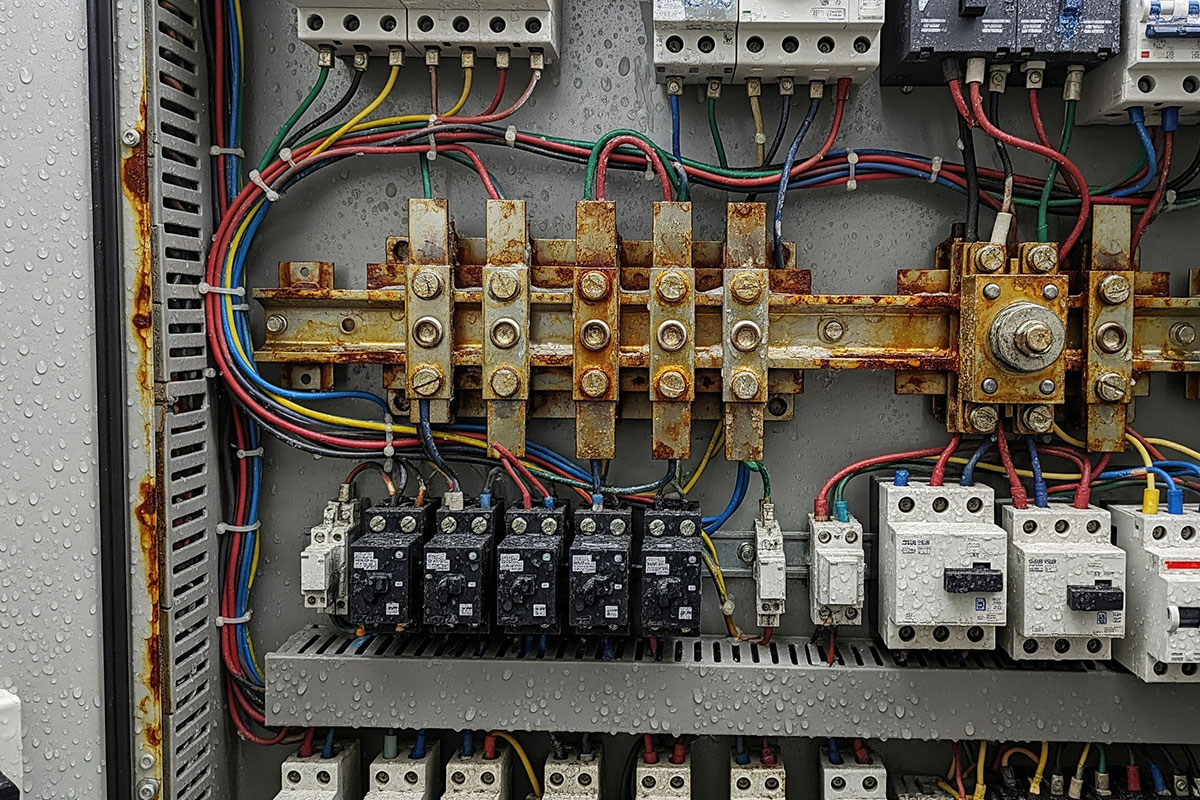
Kolkata’s humid climate isn’t just uncomfortable for people, it’s a silent killer for electrical systems. With average relative humidity levels consistently above 80% for nearly half the year, industrial panels across West Bengal are under constant attack from moisture, condensation, and corrosion. As an electrical engineering company who has serviced over 200 industrial units in the region, we’ve witnessed first-hand how humidity contributes to panel degradation and operational failures.
In this post, we’ll break down the specific ways Kolkata’s climate impacts your electrical panel health, along with proven strategies to mitigate these issues.
Understanding Kolkata’s Extreme Humidity Conditions
From mid-June through October, Kolkata experiences prolonged spells of rain and high humidity. The average RH ranges between 75% to 90%, even during nights. Add in salt-laden air in nearby coastal zones like Haldia and Diamond Harbour, and you have the perfect conditions for moisture ingress and oxidation.
In older factories in Tangra or Liluah, where panel rooms are rarely air-conditioned or moisture-controlled, this leads to significant problems. Humidity doesn’t just sit on the surface, it seeps in, forms condensation, and slowly damages your entire system.
Technical Dangers of High Humidity in Panels
Condensation & Tracking Failures
When warm moist air hits a cooler metal surface inside a panel, it condenses into droplets. These droplets collect on busbars, contactors, and relays, creating paths for current to jump (tracking). This results in flashovers, erratic tripping, or even short circuits.
For instance in a food processing plant in Barasat, where undetected condensation led to the tripping of their MCC (Motor Control Centre) panel. A simple gasket replacement and dehumidifier could have avoided a two-day shutdown.
Corrosion of Busbars & Terminals
Brass, copper, and even aluminium terminals are highly vulnerable to corrosion in humid environments. In West Bengal’s climate, oxidized layers form quickly, increasing resistance at contact points. This often results in localised heating, voltage drops, and eventual connector failure.
We recently replaced the entire busbar chamber in a warehouse near Rajarhat after the original copper bars corroded beyond safe conductivity levels. It could have been prevented by applying anti-oxidant paste and conducting annual thermography checks.
Insulation Resistance Degradation
Humidity reduces the insulation resistance (IR) between conductors and ground, especially in cable joints and panel feeders. We typically measure IR with a 1kV Megger. In high-humidity environments, readings below 20 MΩ for LT panels or 100 MΩ for HT panels are warning signs.
At a logistics hub in Dankuni, our IR testing during July showed values as low as 5 MΩ in a key feeder, far below the recommended safe zone. Servicing was done just in time to avoid a breakdown during the peak cargo season.
Also Read: How Often Should You Service Your HT Panels in Eastern India?
Real Case Studies
In a garment export factory in Howrah, our team discovered severe corrosion in a sub-distribution board fed from the main LT panel. Upon inspection, we found an open cable entry with no gland seal and a panel door without gasket lining. After installing IP-rated enclosures and applying weather-resistant gaskets, the problem did not recur even during the next monsoon.
Another case in a Salt Lake tech park involved a PLC panel controlling HVAC systems that malfunctioned every time relative humidity crossed 85%. The root cause? Fine condensation on I/O terminal strips, which we resolved with panel heaters and controlled ventilation.
Preventive Measures for Humidity Control
Panel Design Upgrades
Always choose enclosures with at least IP55 rating for outdoor panels and IP54 for indoor ones in humid environments. Use silicone gaskets, coated terminal blocks, and anti-condensation heaters. Desiccants like silica gel should be placed in sealed plastic containers inside panels.
In high-density panels, consider applying conformal coating on PCBs and relays. Also, install hygrometers inside critical panels to monitor moisture levels continuously.
Environmental Controls
Panel rooms should be ventilated with exhaust fans and, where feasible, dehumidifiers. If the panel is near a production line that releases steam or vapour (as in textile or chemical units), partitioning the panel area is a must.
For central panel rooms, humidity-controlled HVAC systems are highly recommended, especially for facilities in Rajpur, Baruipur, and other peri-urban zones.
Monitoring Tools
Use hygrothermographs to track temperature and humidity trends. Thermographic scans should be conducted every quarter during humid seasons to catch early hotspots caused by loose or corroded connections.
Also Read: Top 5 Electrical Maintenance Challenges Faced by Kolkata Factories.
Not sure about your panel’s moisture tolerance? Book a free humidity check with our Kolkata team.
Maintenance Best Practices & Scheduling
For factories operating in Kolkata and Eastern India, we recommend a structured servicing plan:
- Pre-Monsoon (April–June): Full IR testing, thermography, gasket replacement, silica refill
- Mid-Monsoon (July–August): Visual inspections, panel heater checks, busbar cleaning
- Post-Monsoon (October): Follow-up testing and preventive replacement of corroded parts
Always maintain proper documentation, including IR test sheets, thermography reports, and moisture readings. These not only help in audits but also in identifying patterns of deterioration.
Also Read: How We Cut Down Operating Costs by Reducing Panel Downtime by 90% at Suri Water Plant.
Protective Solutions for Your Facility
Humidity-related panel failure is not just a risk in theory, it’s a real, measurable problem we tackle every single season in Kolkata. Left unchecked, it leads to production downtime, equipment damage, fire hazards, and audit failures.
ELECTROSERV Engineering provides comprehensive panel moisture control servicing, IP panel upgrades, and IR + thermography inspection plans specifically tailored to Kolkata’s humid climate.
Book an on-site panel health audit today.
Conclusion
Humidity is Kolkata’s invisible electrical enemy. From panel corrosion to IR failure and tracking faults, it compromises industrial panel health in ways that are often underestimated.
As someone who has seen the impact across hundreds of installations, we urge every facility manager and plant head in Eastern India to act proactively.
Don’t wait for the next monsoon. Take control of your panel health today.